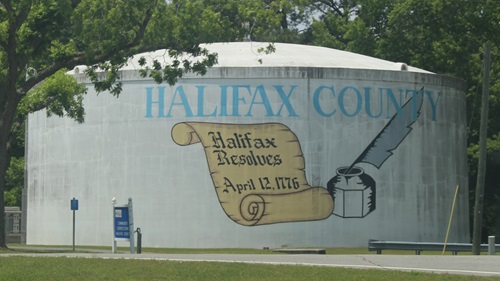
The Halifax Resolves, adopted on Apr. 12, 1776 by the North Carolina Provincial Congress, were the first formal proposal for the independence of the American colonies.
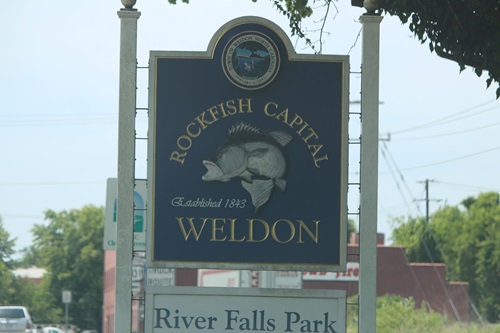
Each spring, fishermen gather in Weldon to fish for striped bass, also known as rockfish, in the Roanoke River.

The scarlet carnation, Ohio's state flower, was first cultivated in the state by Dr. Levi Lamborn. A political rival but personal friend of then-Congressman William McKinley, Lamborn gave McKinley a carnation to wear before each of their campaign debates. McKinley so admired Lamborn's carnations that he adopted the flower as his symbol. After McKinley's assassination, Lamborn urged that the flower be adopted by the state.

Apple Creek lies in Wayne County, home to significant Amish communities, and just north of Holmes County, which has the highest number of Amish in Ohio.

Competitors have flocked to Bowling Green every August since 1967 to participate in the national tractor pulling championship.

Born in Cedarville, James H. Kyle was elected to the Senate to represent South Dakota and is remembered mainly for introducing a bill to recognize Labor Day, which was already being celebrated in some states, as a federal holiday.

As is suggested by its name, Centerburg lies near the geographic center of Ohio.

Gen. James McPherson was killed during the Battle of Atlanta. He was a favorite of William T. Sherman and very popular with his men. Playwright Sherwood Anderson grew up in Clyde and based his Winesburg, Ohio stories on his childhood in the town.

Josiah Fox served the first four American presidential administrations as a naval constructor and designer of Navy ships, including the USS Constitution. Following the War of 1812, Fox settled in Colerain and lived there until his death in 1847. The town is named for Coleraine, Ireland, ancestral home of some of the first settlers.


Ernest Warther's numerous wood carvings, particularly of locomotives, have been on display in his local museum for many years. Elliott Nugent directed many silent and sound films and co-wrote the stage play The Male Animal with James Thurber. Adm. Stout served in both World War II and Korea.

Greene County, just east of Dayton, is the site of the Huffman Prairie Flying Field, where Orville and Wilbur Wright tested their early airplanes. Wright-Patterson Air Force Base is also located here.

Carriage Hill Farm in Huber Heights offers live exhibits tracing the history of agriculture in the Miami Valley.

Mark Hanna was a prominent Cleveland industrialist and political mentor of Ohio Governor and President William McKinley. It is said that when McKinley succumbed to an assassin's bullet, Hanna remarked, "Now that damned cowboy [Theodore Roosevelt] is President".

A member of the Pro Football Hall of Fame for his 14 years as a Detroit Lions defensive star, Dick LeBeau was born in London in 1937. He has been active in professional football as a player and a coach since entering the league in 1959.

Charles Kettering developed an electric cash register in 1906 while working at National Cash Register. At the suggestion of fellow employee Edward Deeds, the next year Kettering formed a team of innovators called the Barn Gang (they met in Deeds' barn), who gathered at night and on weekends to devise improvements for the automobile. Two years later, Kettering's group left NCR and formed the Dayton Engineering Laboratories Co. (DELCO), where in 1911 the company's engineers developed an electric self-starter, eliminating the need for a hand crank. Kettering's team made several other innovations in enhancing the automobile's electrical system.

Originally called Lewisville, Louisville adopted its present name when it was discovered Ohio already had a Lewisville, but retains the original pronunciation. In 1957, the town adopted the nickname "Constitution Town" to honor the efforts of resident Olga Weber to establish the celebration of Constitution Day in Ohio and the observation of Constitution Week nationwide.

Dr. Elton D. Lehman served the Mount Eaton area, practicing family medicine, for 40 years, retiring in 2004. He also served as Mount Eaton's mayor for 15 years. Dr. Lehman passed away in 2016.


John Glenn was the first American astronaut to circumnavigate the Earth, circling the globe three times on Feb. 20, 1962. Thirty-six years later, he returned to space as a member of the space shuttle Discovery's crew. Glenn also served four terms in the U.S. Senate. At his death in 2016, he was the last surviving member of the original seven U.S. astronauts. The New Concord welcome signs are now displayed at Glenn's home, which is open to the public.

Now restored to its 1772 appearance, Schoenbrunn Village was established as a Moravian mission to the Delaware Indians. The town's founders established the future state's first civil code and built its first schoolhouse, but caught between the British-allied Indians and the advancing American frontiersmen, against the background of the American Revolution, the settlement was abandoned after five years.

On Aug. 20, 1835, Christopher C. Baldwin of Worcester MA became Ohio's first road fatality when the driver of the stagecoach in which he was riding lost control of his horses on a downgrade on the National Road, causing the coach to overturn. At the time of his death, Baldwin was serving as the Librarian of the American Antiquarian Society, and had been bound for Zanesville to investigate Indian mounds in the area. Because of the late season and the distance from Worcester, Baldwin is buried in Norwich.

Future President William McKinley lived here from his family's arrival in 1852 to his departure for college in 1859. He later taught school in the area.

Waynesville offers many opportunities for antique shopping at its numerous outlets and also boasts a large number of historic buildings. The town was named for American Revolution General "Mad" Anthony Wayne.


Zanesville is home to the Y Bridge, which crosses the Muskingum River at its confluence with the Licking River. The current bridge, which opened in 1984, is the fifth in a series of bridges dating from 1814. The bridge allows traffic to cross between the north and south banks of the Muskingum or to remain on the south bank, but cross between the east and west banks of the Licking. A traffic light controls the junction in the middle of the Muskingum.


One of many Pennsylvania towns with Welsh-derived names, Bangor was the home of Homefront Magazine, published 1942-1946 by Horace and Mona Strunk to keep families in the Bangor area in touch with their members in the service. Bangor is located in northeast Pennsylvania's Slate Belt.

For many years, Bloomsburg was the only municipality in Pennsylvania to be incorporated as a town. All the others are boroughs, cities and townships. McCandless in western Pennsylvania incorporated as a town in 1975.

Chartered six days after the 1783 signing of the Treaty of Paris ending the American Revolution, Dickinson College is the first institution of higher learning established in the independent United States. A project of Dr. Benjamin Rush, the school was named for John Dickinson, renowned as the "Penman of the American Revolution," and was established on land owned by Mary Dickinson. The Dickinsons contributed an extensive library to the institution. Rush proposed the name John and Mary's College for the school, but Dickinson College was chosen instead. Carlisle was named after the English town of the same name.


Clarion University is part of the state secondary education system. The Autumn Leaf Festival is held in October each year.